Victor Samuel Johnson was born in Nebraska, and grew up on a farm there. As a young schoolboy he had to study by the flickering light of a flat wick kerosene lamp. In spite of this, he learned his lessons well and became a bookkeeper, and a salesman, for the Iowa Soap Company in Burlington, Iowa.
In 1905 Victor saw a German lamp that produced a superior non-flickering light by using a cone shaped "mantle" which was suspended above the lamp's round wick. When lit, the flame heated the mantle, causing it to glow brightly producing a brilliant, non-flickering, white light. The German lamp's round wick, and center draft tube, also allowed the lamp to produce a very even burning flame that did not flicker.
It did not take Victor long to realize the sales potential of such a lamp. In 1908 he incorporated "The Mantle Lamp Company of America" and in early 1909 the first "Aladdin" lamp was introduced to America.
The name Aladdin was actually derived from the story of Aladdin and his wonderful lamp-- in which old lamps were offered for new. One of the sales programs of the Aladdin Mantle Lamp Company followed the story line by uniquely allowing a trade in allowance for customers' old lamps. Many Aladdin lamps were also given away as part of their introduction to the public.
As The Mantle Lamp Company of America grew from the sales of the Aladdin lamps, it also diversified into many other products. Aladdin Industries, Inc.” was created as a subsidiary in 1919 to market its diverse product line. In 1949, The Mantle Lamp Company of America rolled up this subsidiary and became known by that name. This firm is still producing a variety of products, but is probably best known for the Aladdin thermos products it manufactures. In 1999, a group of Aladdin enthusiasts headed by J.W. "Bill" Courter and Tom Teeter purchased the Aladdin Mantle Lamp division from Aladdin Industries. The new company became known as "The Aladdin Mantle Lamp Co." at that time.
It is hard for most people, in this day and age, to think back to a time without television, streaming video, cell phones, and electrical appliances. Yet if they stop to think back on it, everyone, at one time or another, has experienced a power outage which was quick to remind them of their pampered lifestyles. For it's only in the total darkness of a power outage that we begin to realize the value of a mere 60 watt light bulb. Only in that total darkness can the people of modern day experience, in a small sense, what the Aladdin mantle lamp meant to those who bought them. The Aladdin lamp with its "rare earth oxide mantle" not only brought a light into the darkness, it changed the lives of millions of people as it did.
When I look upon the lamps in my collection, I see more than just pretty pieces of glass-- I see the people that used them and feel a little remorse in their passing. The lamps are the epitaph to a way of life I never knew. I can't look upon them without wondering where they have been. What good, or bad, times have they brought from the darkness? They are history, and for a short time I am their keeper--then I too shall become one of their secrets.

If there is one piece of advice I would convey to the new collector, it is to be patient. You will be tempted to buy the first lamp you find in a particular style. You will probably think that if you don't buy this lamp, you may never find another like it. Don't make that mistake! Be selective and don't settle for a lamp of lesser quality, believing you will never find another like it. The key to finding those lamps is to be mobile! I have traveled hundreds of miles throughout Iowa, Nebraska, Minnesota, Kansas, Missouri, Illinois and Wisconsin. I have seen thousands of Aladdin lamps, and you will as well if you are willing to seek them out.
One of the best places to find lamps is at the regional gatherings of the Aladdin Knights. Their web page contains some very good information and will show you where you can obtain parts for your Aladdin lamps. Yes, the mantle, gallery, flame spreader, and chimney are still being produced and can be obtained for those lamps missing them! You can also order the newest book on collecting Aladdin kerosene lamps (Aladdin, the Magic Name in Lamps by J.W. Courter) as well as the latest price guide. You will never find a better source of information than these two books, or a more knowledgeable group than the Aladdin Knights when it comes to collecting Aladdin lamps.
The other thing I would like to touch on with those of you who are new to collecting, is to remember that you set the prices for the lamps you buy! The price guide that is available is only that--a guide. The price of a lamp should be determined by its condition. If the burner is incomplete, the color is poor, or the lamp is chipped, it should not bring the same price as one in perfect condition. Be patient and be selective. If you are willing to buy a lamp that isn't perfect, then make sure you buy it for a price that is reflective of that fact. It's hard to pass up a lamp you have hunted long and hard to find, but make sure it's up to your standards so you don't find yourself wanting a better one as your collection grows. If you won't be happy with it forever, then don't buy it!!
Another bit of advice is that many of you will be tempted to piece together a lamp when you aren't able to find it complete. There isn't anything wrong with doing this, as far as originality is concerned. Lamps are made up of parts and as long as all those parts are original, a lamp made from parts is no different than the original lamp itself. There can be, however, a very big difference on how much you end up spending on your parts lamp! You need to know what those parts are worth before you even think of putting together a lamp from them. Let's say, for example, you find a beautiful model #7 fount but it's missing the burner and flame spreader. Couldn't you just buy the fount and then later buy a burner and flame spreader to complete it? Well, yes you probably can, but that little thimble of a flame spreader will cost you a hudred bucks or so, if you can find one for sale. The burner will add another hundred or more as well. The metal lamps are the worst for this because the burners and flame spreaders are pretty much model specific, and hard to find in good condition. The glass lamps use the model A and model B burners, which are easier to find, but even then, remember that the burner is worth around sixty dollars at present prices. A "NEW" gallery will cost you about forty dollars, a chimney and mantle another fifty dollars or so. Is this beginning to sink in? Don't pay top prices for lamps that are less than perfect!
Spend your money carefully and you will be very happy with what it buys!!
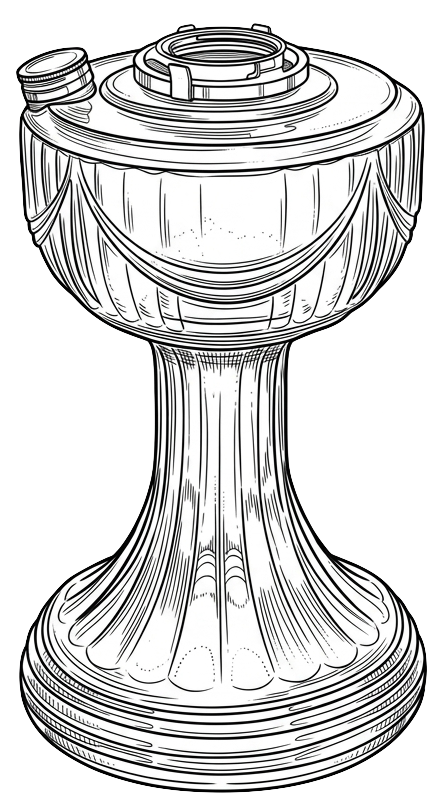
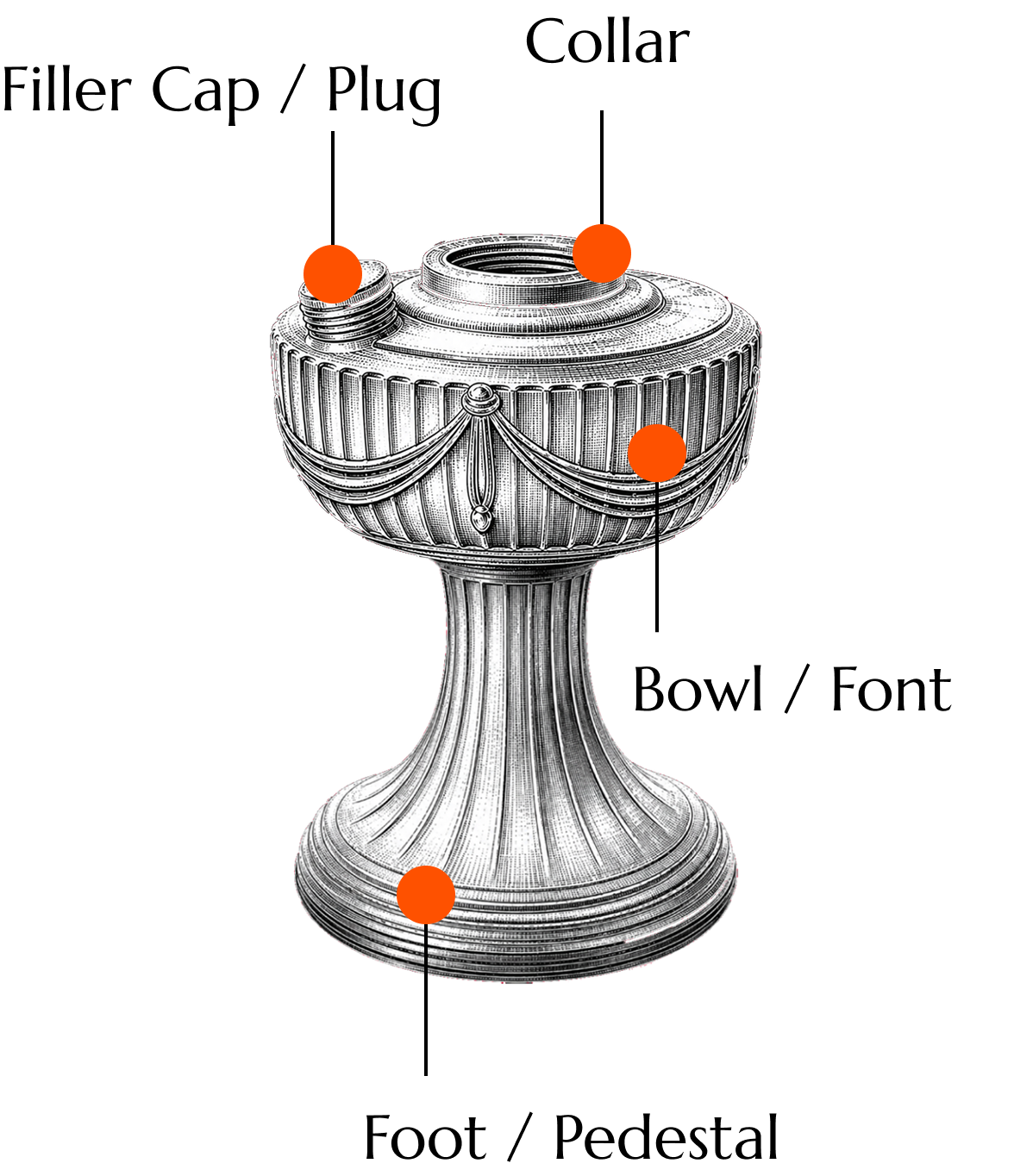
An Aladdin lamp is made up of more parts than most people realize, and knowing what to call each one makes all the difference — whether you're describing a lamp to a fellow collector, shopping for a replacement piece, or simply trying to figure out what's missing from the one you just brought home. From the font and gallery to the flame spreader and chimney, this visual glossary walks through each part of the lamp so you can identify them at a glance. Click on any part below to see where it fits on the lamp and learn what it does.
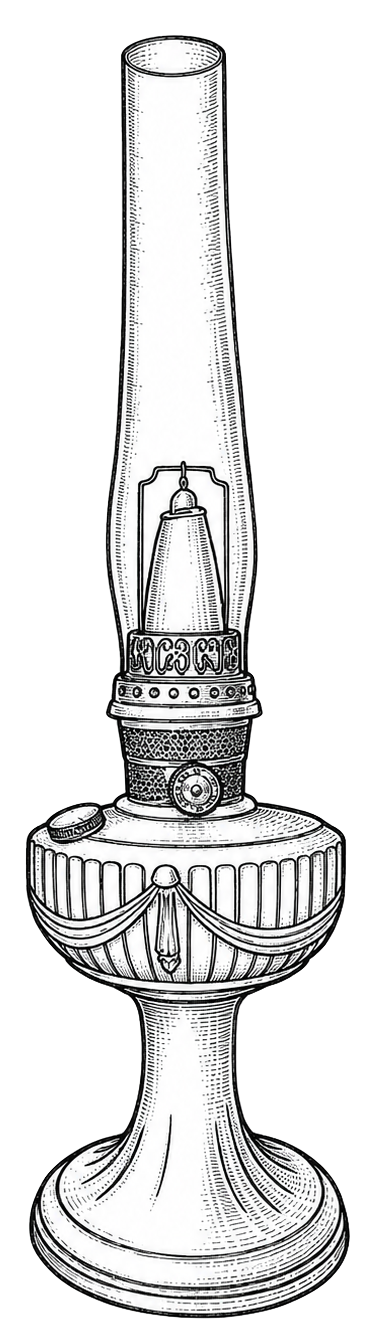
Click on the parts above you would like to know more about!
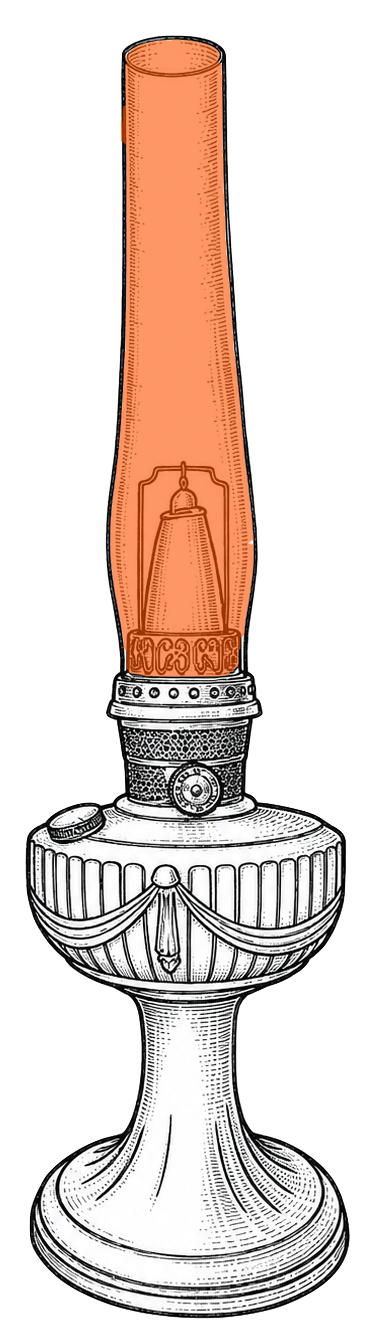
The tall glass tube that sits atop the burner assembly. It creates the draft needed for proper combustion, shields the flame from drafts, and encloses the glowing mantle.
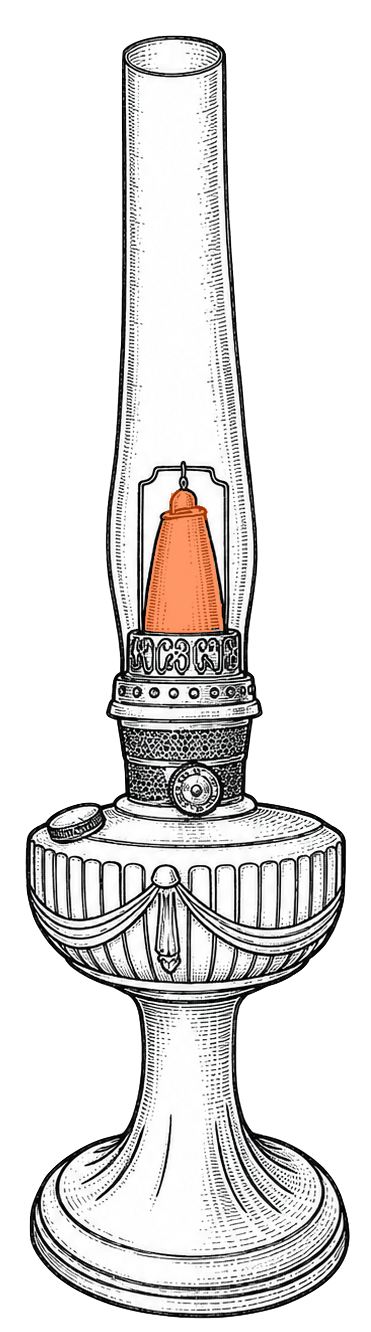
The delicate woven mesh, treated with rare-earth oxides (typically thoria or ceria), that glows with a brilliant white incandescent light when heated by the flame. This is what gives Aladdin lamps their distinctive brightness compared to an open kerosene flame.
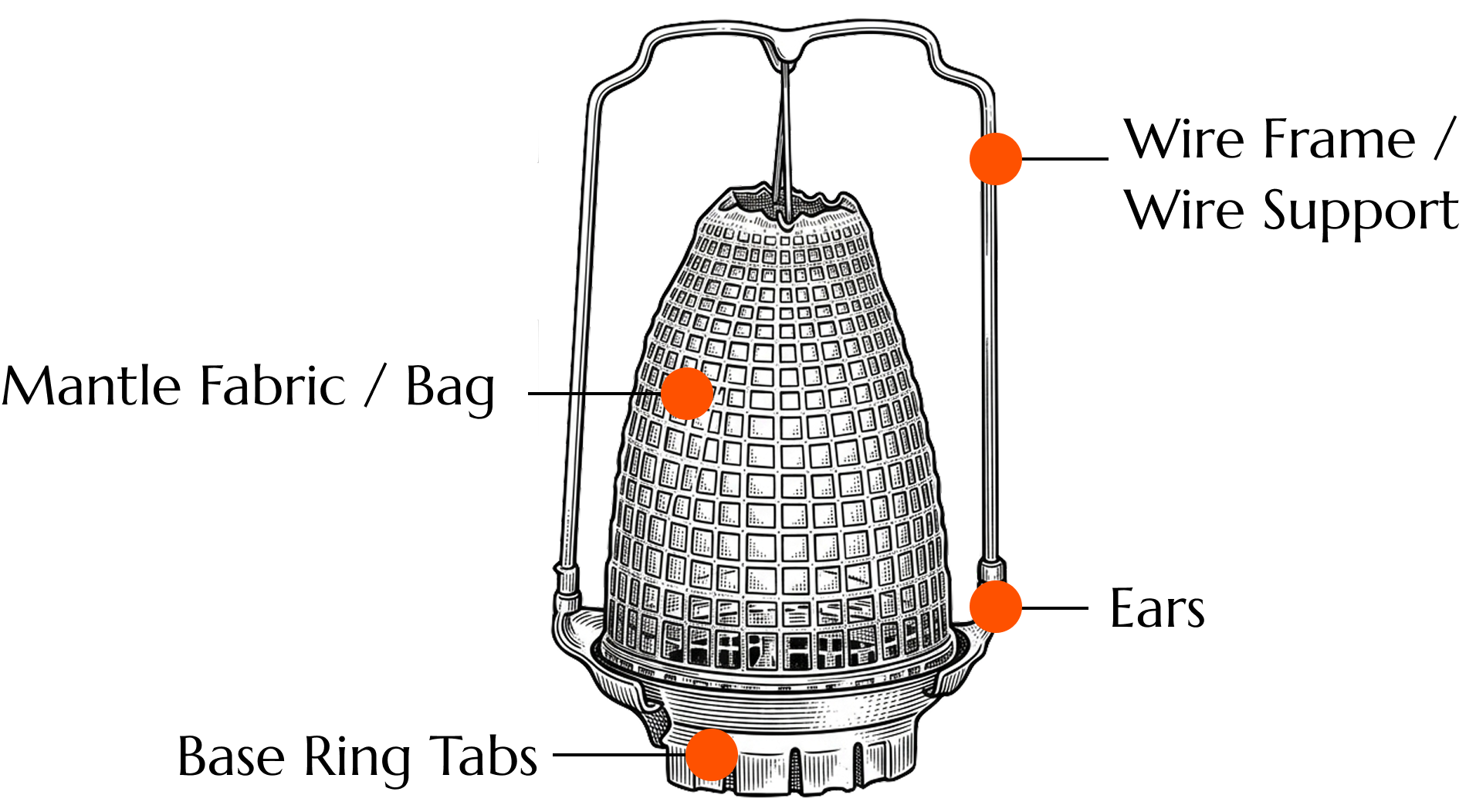
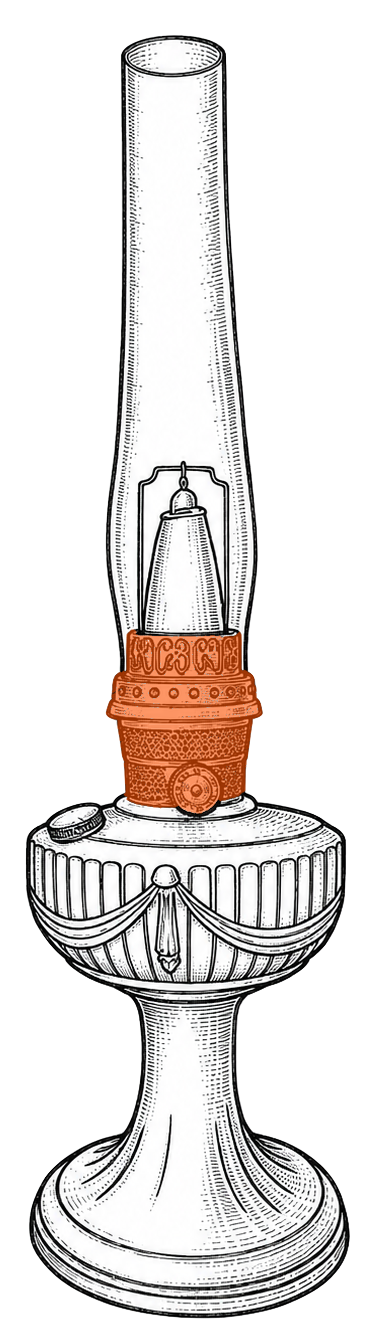
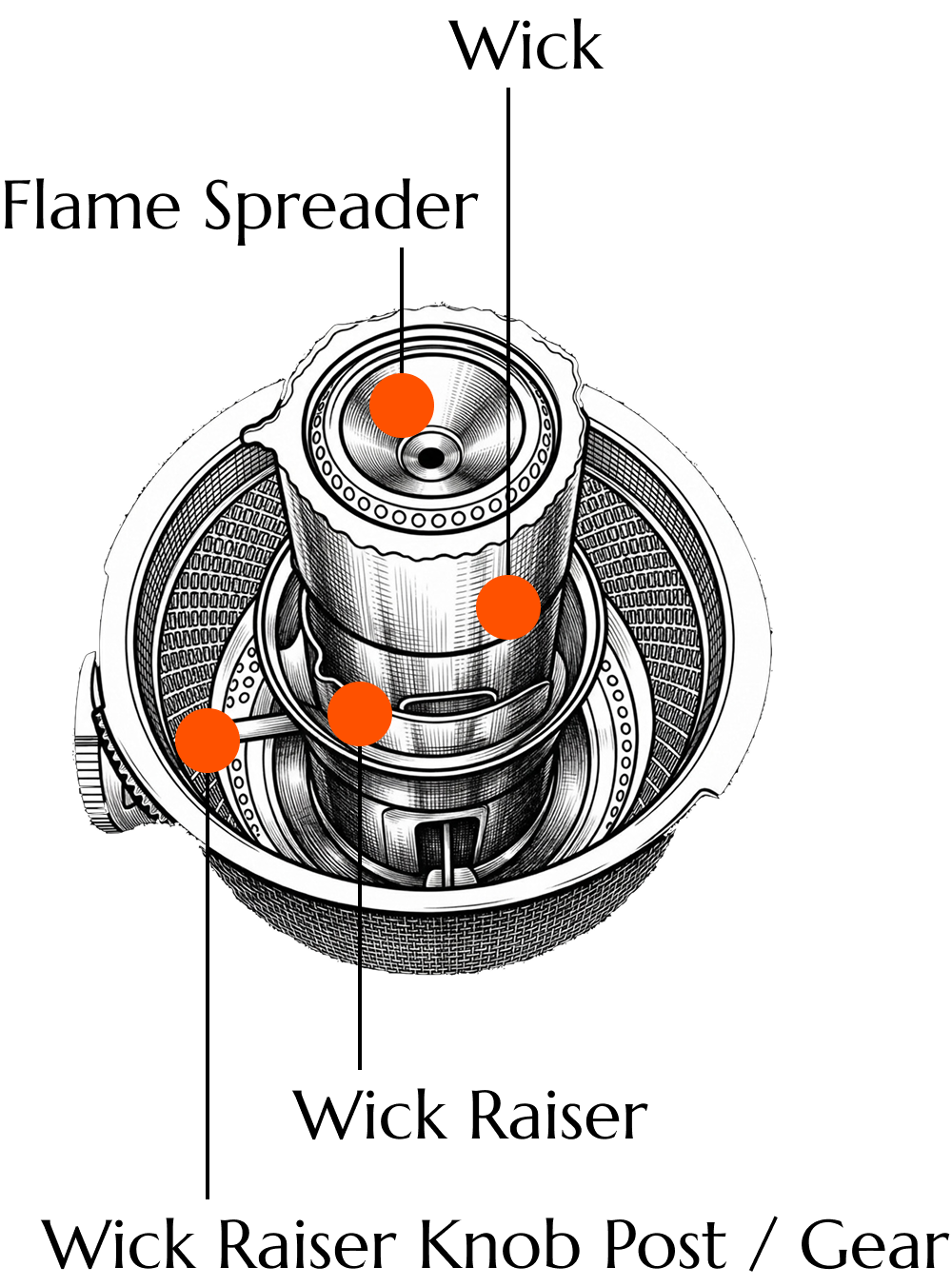
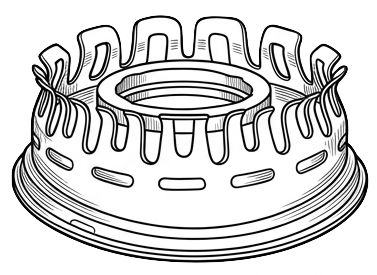
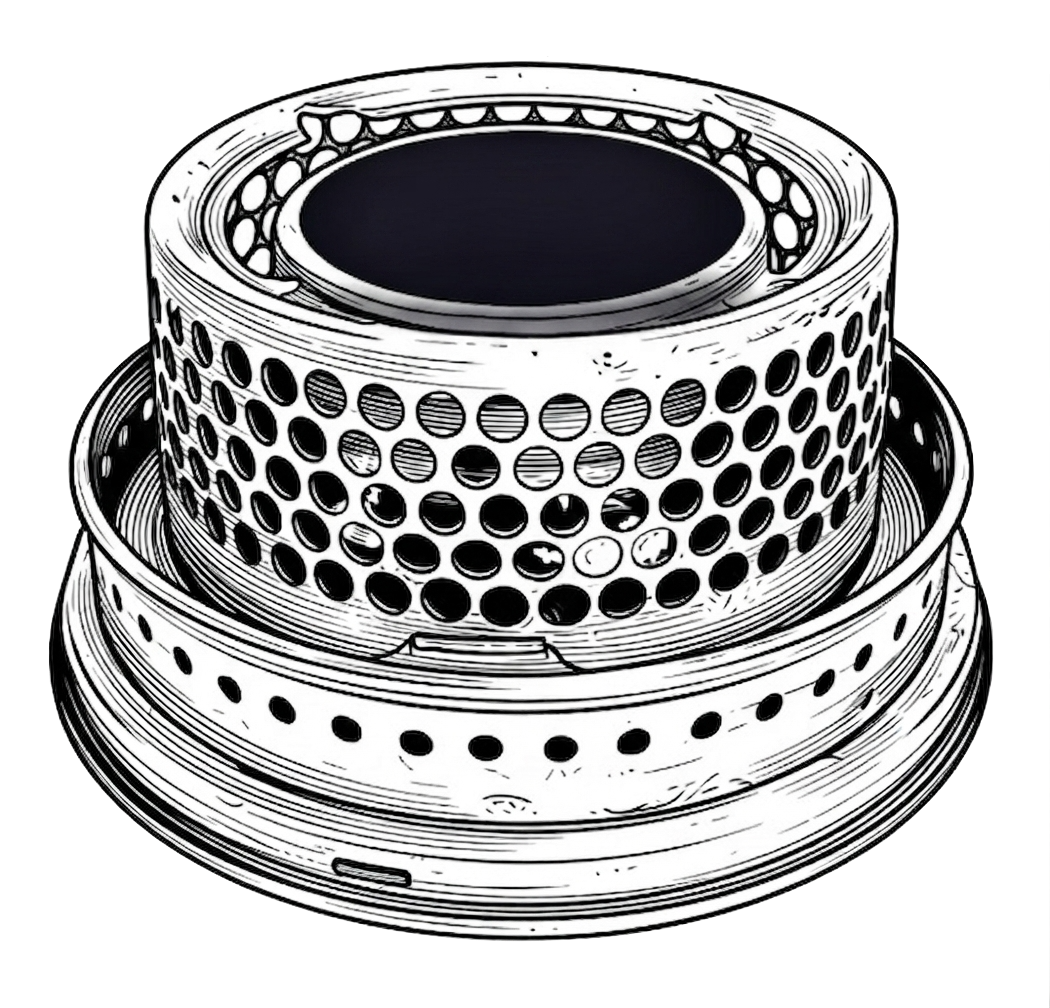
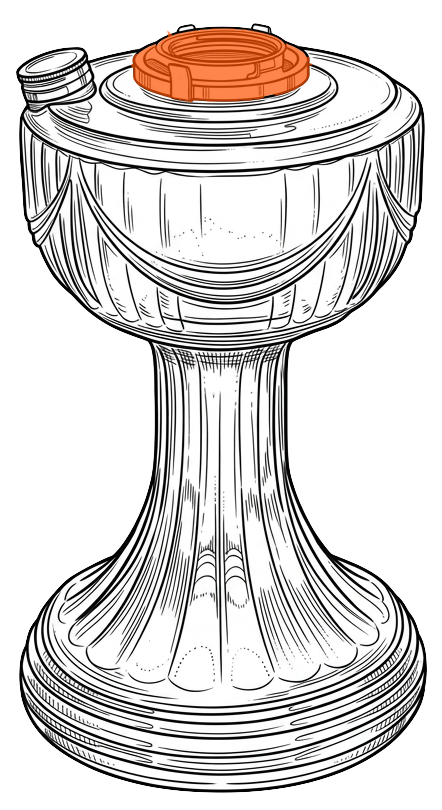
The complete mechanical unit that sits atop the font and produces the lamp's light. It combines the wick tubes (inner and outer), post/gear and wick raiser knob, air distributor, flame spreader, burner basket, and gallery into a single assembly that threads or locks onto the font's collar via the base ring tabs. Together these parts draw fuel up through the wick, regulate airflow, shape the flame, and hold the mantle in the correct position to produce Aladdin's signature bright white light — with the chimney fitting over the top to complete the draft and enclose the flame.
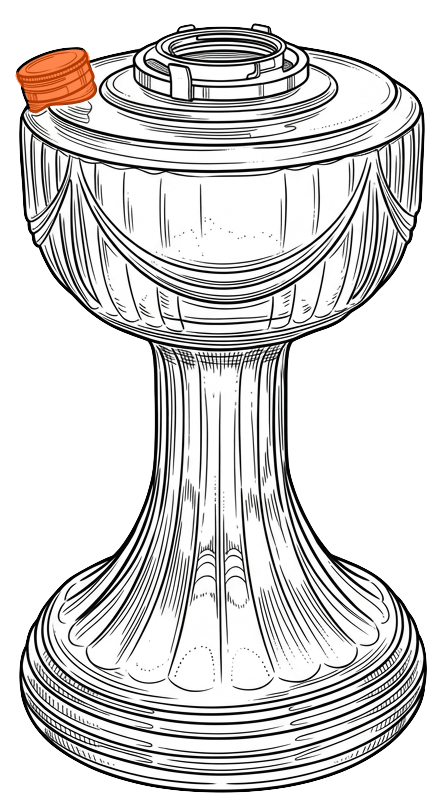
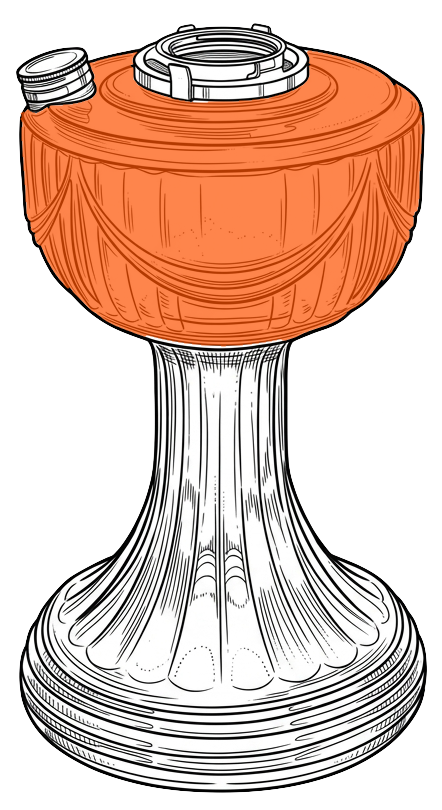
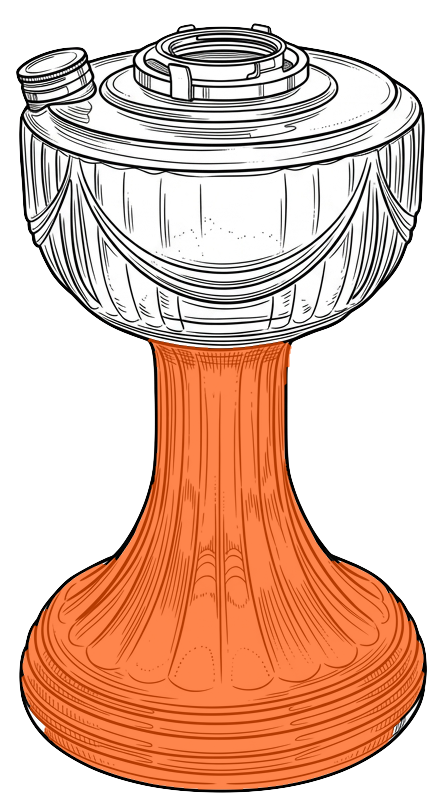
Click the name of each part below to see its diagram.
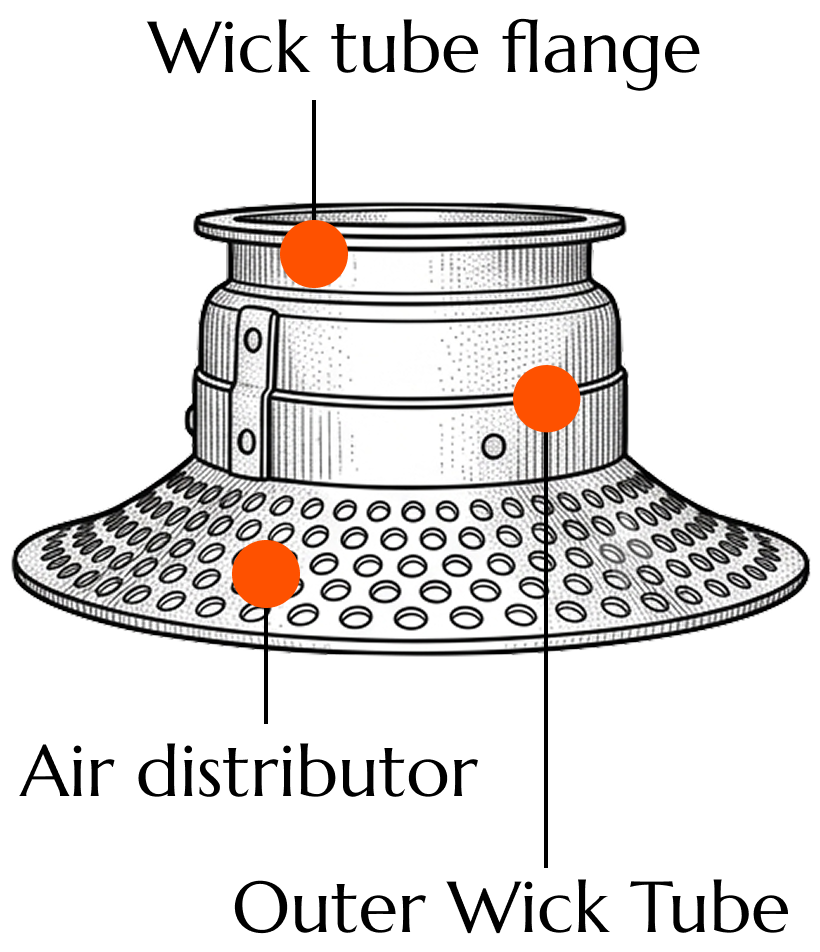
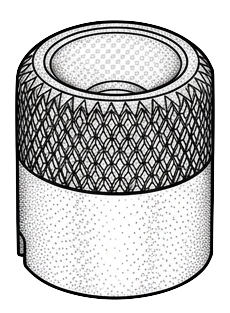
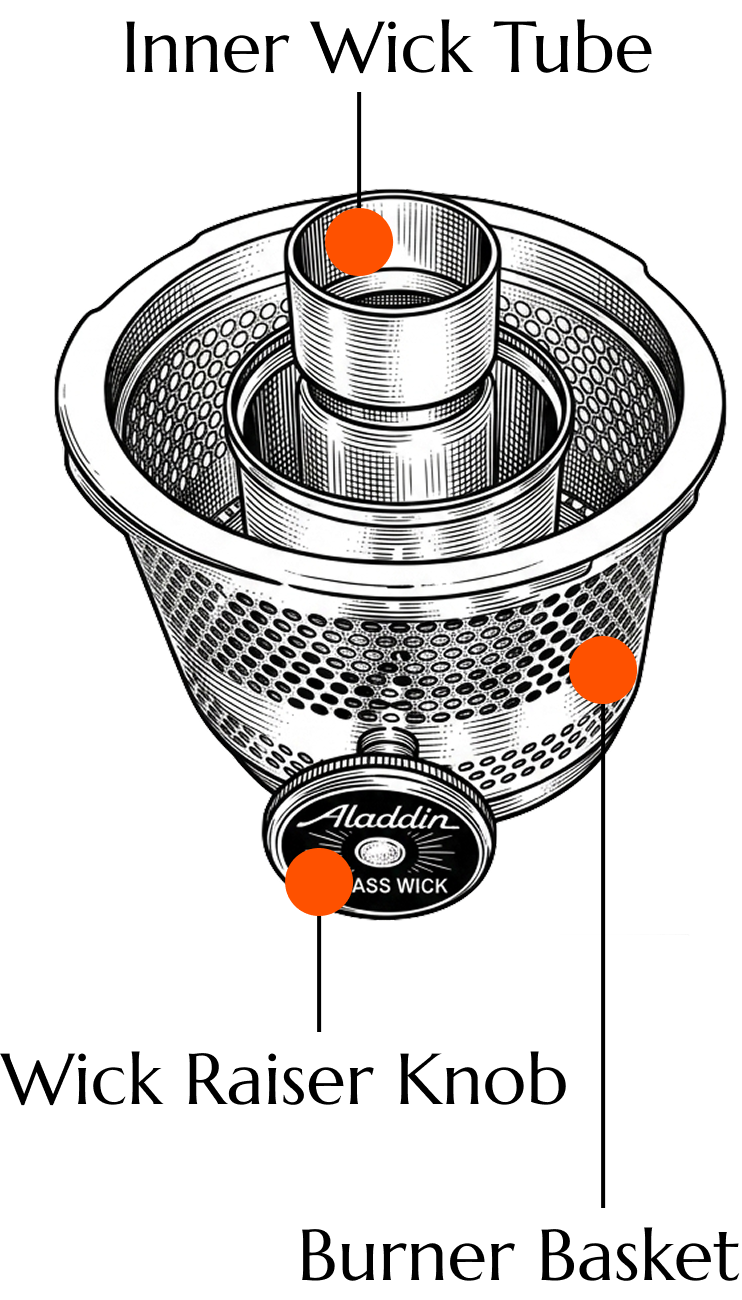
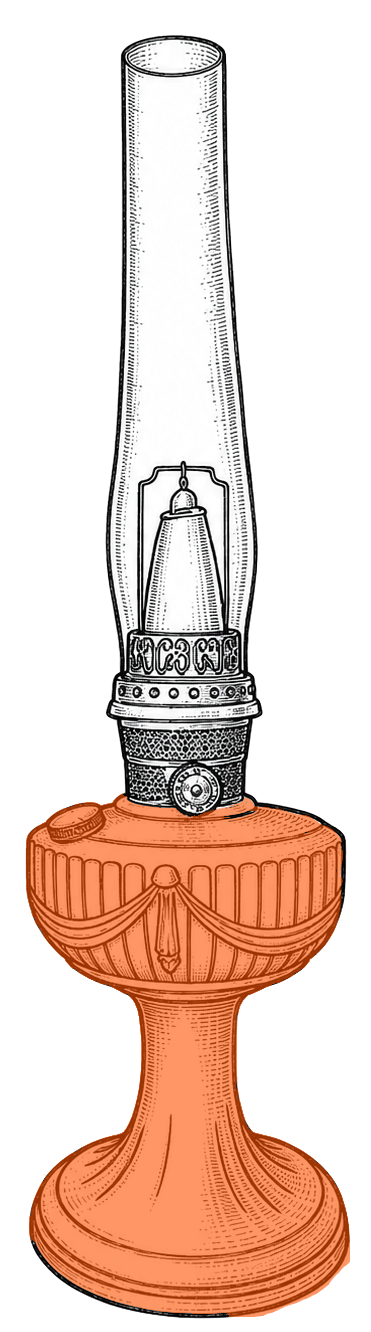
The fuel reservoir on a table lamp — the vessel that holds the kerosene and to which the burner attaches at the top. "Font" is the term specific to table lamps; the equivalent part on a hanging lamp is usually called the "bowl."
Collecting Aladdin lamps is a rewarding pursuit, but knowing what to look for — and what to do when you find it — makes all the difference. These tips have been learned the hard way over years of hunting, cleaning, and restoring, and are shared here in the hope that they save you some of the same hard lessons. From cleaning burners and spotting reproductions, to the tools you should never leave home without, there is something here for collectors at every level.
Click on the title you wish to learn about below.
How do I clean the burners on the Aladdin lamps I buy?
What has worked for me on brass burners is a cleaner called "CLR" which can be found in most hardware stores. Take the burner apart and soak the parts in a 1 to 1 mixture of CLR and water. On really dirty burners, you may want to let them soak overnight. Use a small brush to scrub them off the next morning and rinse with water. Once clean, dry all the parts with a hand held hair dryer. This heats up the parts and dries the cracks and crevices you can't reach! Now use Brasso (also found at your local hardware store or supermarket) to polish up the brass. It will look like new when you are done.
Use easy off oven cleaner--the yellow top can. Take the burner apart and spray down the parts with the oven cleaner. Let them set for five or ten minutes and then wash them down with water. (Wear plastic or rubber gloves when working with it!) You may need to repeat this a couple of times, but the burners should clean up nicely. Again when done, use a hand held hair dryer to dry the parts. You can polish the burners up using Silvo--found right beside the Brasso in the hardware store or supermarket.
Funny, a hair dryer can be such a tool in lamp collecting . Try it for burners that are frozen in lamps. Remove the parts of the burner that you can, then take a hand held hair dryer and set it to high heat. Keep it just three or four inches from the burner and heat the burner up well. Turn the base slowly so you heat the burner all the way around. Use a hot pad holder once the burner is hot and see if it will unscrew from the lamp. Don't use a lot of force; it should turn out with normal pressure. If it doesn't, let it cool down for a while and then repeat the process. I have never failed to get a frozen burner out of a lamp using this method. One caution---do not do this if the lamp is cold from being outside or with a lamp that has kerosene in it! (Be very careful when working on the glass jointed lamps when using this process.)
You will hear people talking about the "Amberina" in the red Aladdin lamps. This refers to that part of a red lamp that appears to be more amber than red--usually most noticeable on the outer most rim of the foot and traveling upward toward the font. The less Amberina and the darker the red color, the more desirable the lamp. The Amberina is best judged with the red lamp sitting on a white surface. Since you may often find them sitting on a dark table or other dark surface, try carrying a white sheet of paper with you. Computer printer paper works very well. Place the lamp on the white paper and you should easily see the degree of Amberina in the foot. The less, the better. This also works well for judging the color of other dark colored lamps such as amber or cobalt.
Where can I get small brushes to clean my burners?
Try a music store. Find where the school band rents or buys their instruments. You will find all kinds of brushes made to clean these instruments. They are made to reach into small cracks and crevices and to take a lot of abuse as well. And most of them don't cost a lot either!
What does a black light do and where can I get one?
A black light can be used to tell the "old formula" alacite from the new. The old formula will glow a yellowish green color under a black light, while the new formula will not glow at all. You can also use the black light to spot cracks or repairs. Most new glues will glow under a black light, as well as cracks in the glass. The only problem you will have is that most places where you find lamps aren't dark enough for the black light to work properly. You may need to try putting it under a table, or if they will allow you, take it to a closet or restroom where you can turn off the light and use your black light. Some antique malls have black lights available that they may let you use to examine merchandise or they may have them for sale. I have a small one that I purchased at the local Brass Armadillo Antique Mall that will easily fit into a purse or belt pack. I also have a larger one that I purchased through Bass Pro Shops. The larger one was actually cheaper and gives off a lot more light but isn't quite as portable. It can, however, fit nicely into the trunk of your car and doubles as an emergency light since it has two blacklight tubes and two fluorescent tubes!
How do I tell a reproduction lamp from an old lamp?
This question is most often asked in reference to the tall and short Lincoln drape Aladdin lamps, which are the only two lamps reproduced by Aladdin or anyone else. The differences are simple to see if you know where to look. For the short Lincoln drapes, simply look at where the burner screws into the lamp--if there is a raised metal collar, the lamp is new. The tall Lincoln drapes take a little more examining. The key difference is that the old lamps were molded as one piece, while the reproductions were molded in two pieces and glued together. You will be able to see where the bowl is glued to the stem just above the filigree design of the stem. Also note that the mold lines on the stem and the bowl will not line up on the new lamps. If you turn the lamp upside down and look at the pattern on the bottom (commonly referred to as the "crows feet") you will see a pattern of faint lines running across the band containing the crows feet design. (They can be quite faint so you may need a magnifying glass.) The presence of these lines means the lamp is old, the absence means it is new.
Ever wonder what you should use to glue Aladdin lamps like the Corinthians, Queens, or Orientals together?
Nobody knows for sure what Aladdin used as an adhesive to connect their lamps, but I'll share my thoughts.
I believe the original glue was "hide glue" because it was a widely used adhesive in industry at the time, and it was also heat sensitive. Yes it still exists and you can still buy it on Amazon. Have I ever used it,-no. I haven't used it because I don't want my joints to be heat sensitive.
Aladdin also used Sauereisen cement as an adhesive to fasten the oil fill threads to lamps. I also believe they used it as an adhesive on the Majestic and Queen lamps.
So today, I use something similar on many of my two piece lamps. It's a premixed tile adhesive grout. Being premixed it can be molded like putty and formed to fit the connectors on you lamp. It also gives you plenty of work time to make sure the parts are straight and level. I've used it on several lamps and I am very happy with the results.
Yes there are plenty of other adhesives that will work as well, but this is the one I choose.
A word of caution! Often when inspecting or cleaning lamps you will remove the oil fill cap and run your finger in the hole to see if you can feel any glue, or to make sure the glass hasn't been broken---be very careful and especially so on lamps that have recessed oil fills where the cap screws into threads that are glued down (such as the Venitians and Cathedrals.) The recessed metal threads may not cover all the glass and that glass is sharp! It pays to inspect this area for repairs or cracks but do it with verylight pressure or with gloves to avoid being cut. Yes I found this out the hard way, and more than once--I'm a slow learner!!
One of the first things you will want to do when you get your lamp home is to clean it up. If you find a nice painted Orientale (I know you are smart enough not to use a cleaner that will harm the paint right?) just wash it off in nice warm soapy water so you don't hurt the paint--everybody knows that huh? Well when you do this and your pretty green Orientale suddenly looks like you washed it in milk-- then dries down with a white opaque layer covering all that pretty green-- don't get hysterical. Get a shoe shine brush, and buff that lamp!! I'm not sure whether this phenomenon is due to someone putting auto wax on the lamp, or something in the finish from the factory, but it will buff back to a shine if you keep at it. It happened to me, and after my wife and I got over crying, I decided to try the shoe shine brush just in case it was wax. Sure enough it buffed out looking as good as new, but it was an experience I could have done without!
One thing a lot of people don't think about when out looking for Aladdin lamps is to carry the tools with them that will help them judge their condition. I would suggest getting a belt pack--commonly referred to as a "fanny pack"--which will easily allow you to carry a few simple tools along with you. Invaluable tools are: a black light, a piece of white paper or cloth, a magnifying glass (the ones with a small light built in are great), and a small tape measure. I have also included a small flashlight that has the lens mounted on the end of a flexible cable. I can remove the burner from the lamp, then bend the cable at a 90 degree angle and put the lens inside the oil font. This allows me to backlight the glass bringing out any flaws in the color or glass! Having these tools with you will give you a real advantage in judging the condition of any lamp you might find.
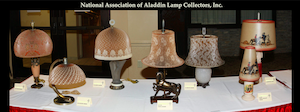
Aladdin collectors come together each year at both a national gathering and several regional meets — great opportunities to buy, sell, trade, and connect with fellow enthusiasts. Lamp shows are generally open to the public for a small admission fee, with full participation requiring membership in the Aladdin Knights.
For dates, locations, registration, and membership information, visit the National Association of Aladdin Lamp Collectors, Inc.
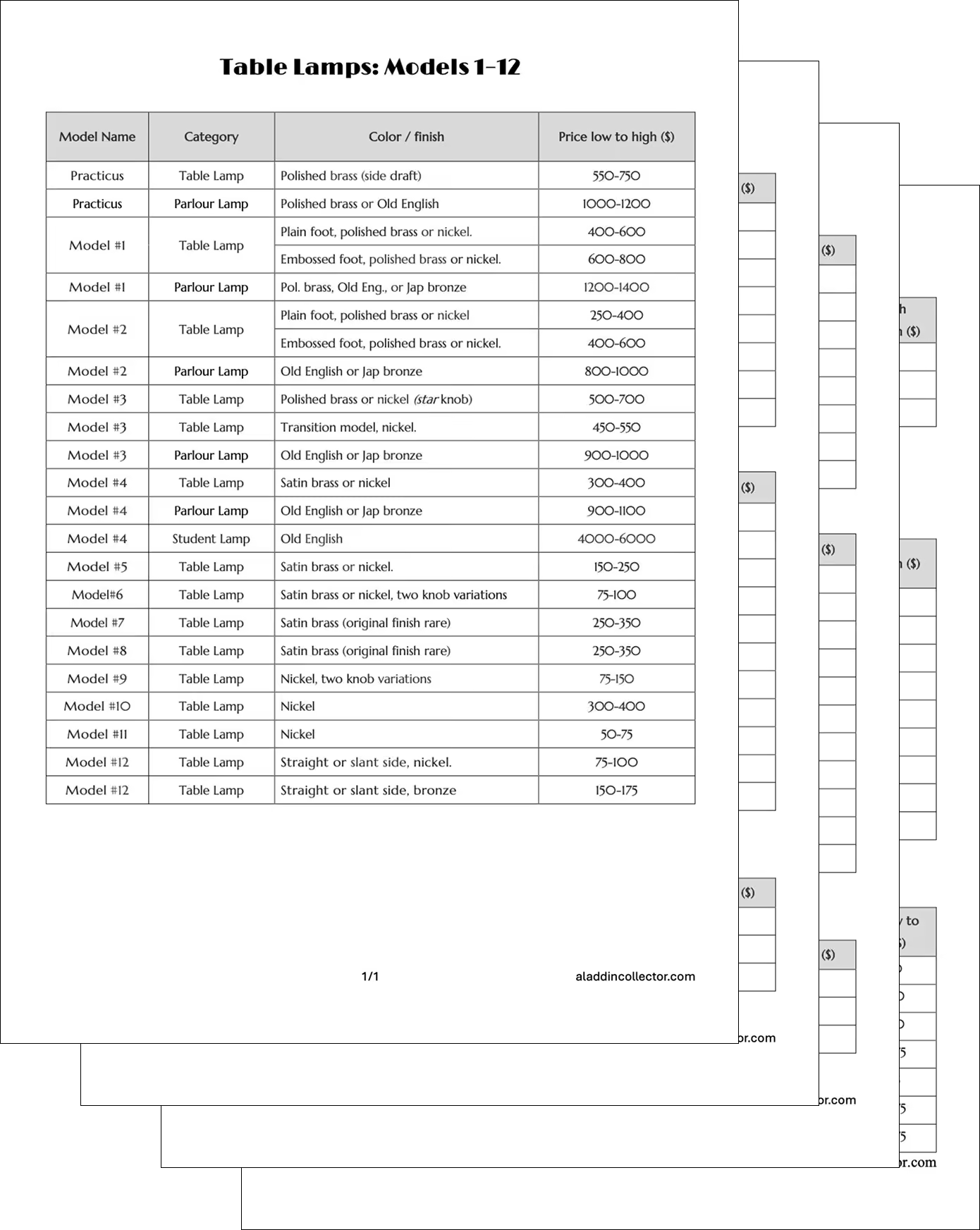
Collectors often ask what their lamp is worth, and this price guide gives current value ranges based on recent auction results, dealer sales, and collector marketplace activity. Prices run from poor finish (heavy wear, chips, or damage) to excellent finish (little to no wear, original parts, and strong original color). Actual value also depends on color or style rarity, completeness of the burner and original parts, regional demand, and glass or metal condition, and since reproductions can resemble valuable early models, some styles are flagged with a “beware of new lamps” caution. The guide is updated periodically, is meant as a general reference for buying, selling, and insurance rather than a formal appraisal, and is organized into tabs by the period when the lamps were originally sold.
To browse the full price listings, please visit our separate price guide page.